The second quarter of 2026 proved to be a defining period for global fixed income markets. Continuing tensions in the Middle East, volatile energy prices, and diverging central bank policies created a challenging environment for market participants. Despite these turbulences, fixed income futures markets demonstrated remarkable resilience, supported by strong trading activity, deep liquidity, and stable execution costs.
Geopolitics and central banks shape market direction
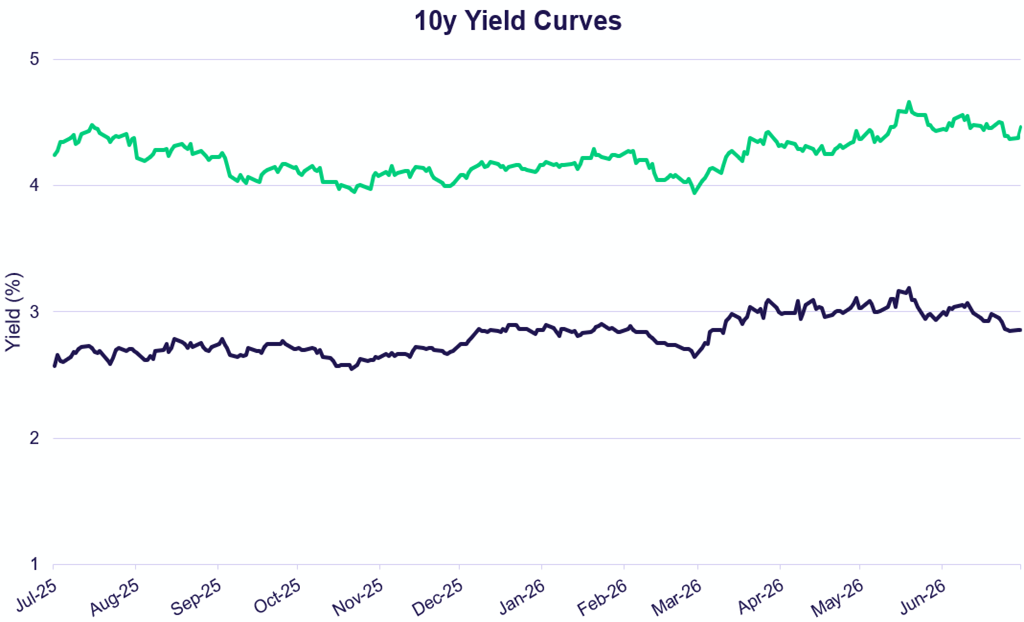
Throughout Q2 2026, government bond markets were heavily influenced by concerns over energy supply disruptions stemming from the Middle East conflict. Bond yields initially rose sharply as oil prices surged and inflation fears intensified. However, yields retraced later in the quarter after a U.S.-Iran ceasefire framework eased concerns over prolonged supply disruptions.
Monetary policy divergence also played a significant role. While the Federal Reserve maintained its policy rate within the 3.50 percent–3.75 percent range, the European Central Bank raised rates to 2.25 percent in response to energy-driven inflationary pressures.
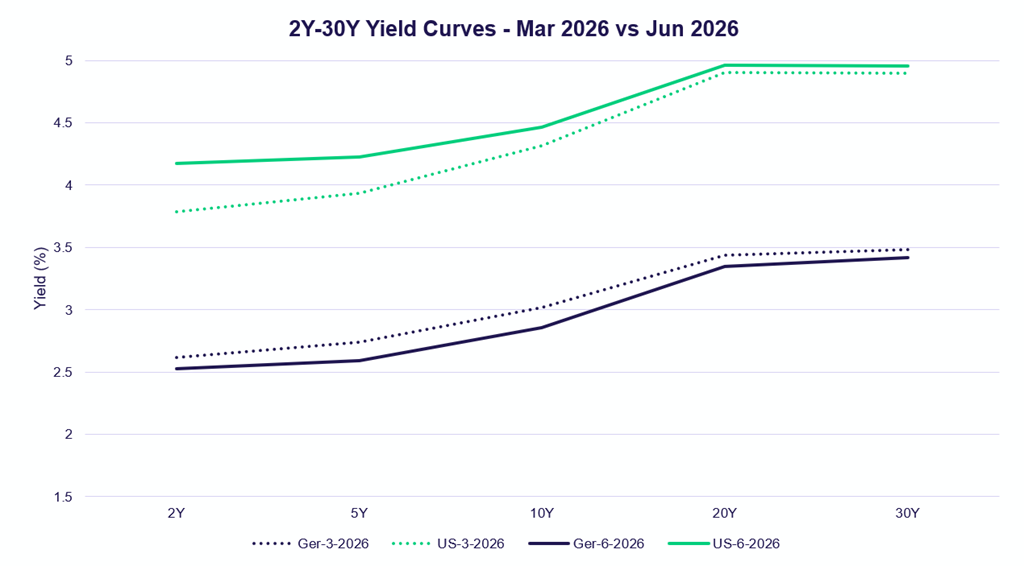
Diverging paths for U.S. and German yield curves
The differing macroeconomic backdrop was reflected in yield curve developments. U.S. Treasury yields increased across the curve, while German government bond yields declined. By quarter-end, the U.S. 2s10s curve stood at a spread of 29 basis points, compared with 33 basis points in Germany. Meanwhile, the 10-year BTP-Bund spread tightened to 77 basis points, indicating improved sentiment toward peripheral European debt.
These movements highlight how investors navigated a complex environment characterized by geopolitical risk, inflation concerns, and different policy responses on either side of the Atlantic.
Eurex fixed income futures gain momentum
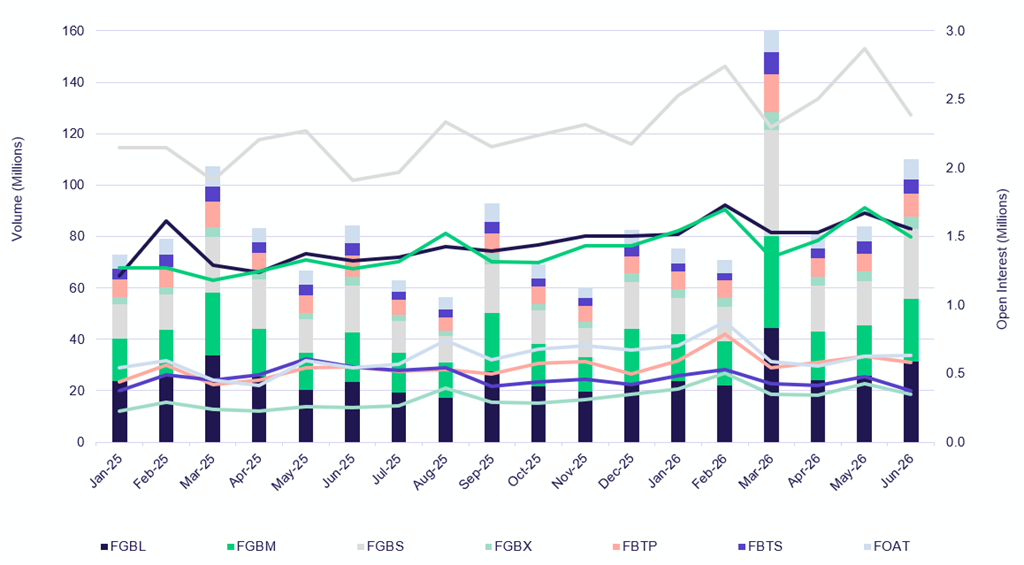
Against this backdrop, trading activity across Eurex's fixed income futures complex remained exceptionally strong. Total benchmark government bond futures volumes increased by 17 percent year-on-year in Q2 2026, where volumes declined by 2 percent over the same period.
German government bond futures led the growth, with trading volumes reaching 218 million contracts, representing a 21 percent increase year-on-year. French and Italian government bond futures also recorded healthy growth, reflecting continued demand for hedging and risk-transfer instruments.
Open interest trends reinforced this positive picture. The German segment recorded a 22 percent year-on-year increase, while Italian FBTP contracts rose 6 percent and French OAT futures increased 17 percent .
Traded volume and open interest at Eurex
Liquidity remains robust through volatility
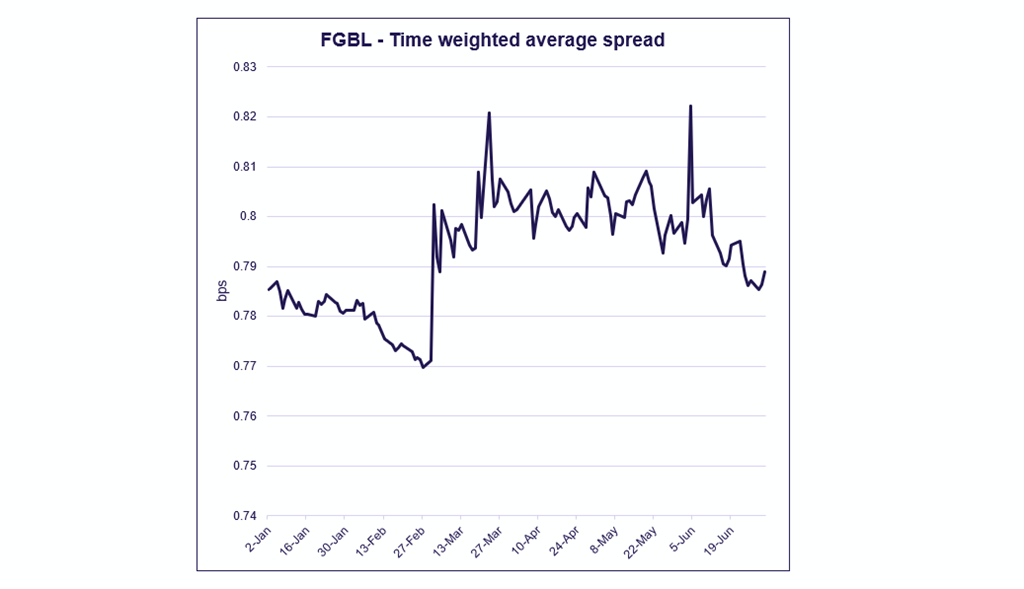
One of the most notable developments during the quarter was the resilience of market liquidity. Despite heightened uncertainty, execution costs remained stable across key contracts. Average time-weighted bid-ask spreads were approximately:
FGBL: 0.80 bps
FGBM: 0.88 bps
FGBS: 0.48 bps
These levels remained largely unchanged throughout the quarter, demonstrating the strength of the Eurex liquidity ecosystem even during periods of market stress.
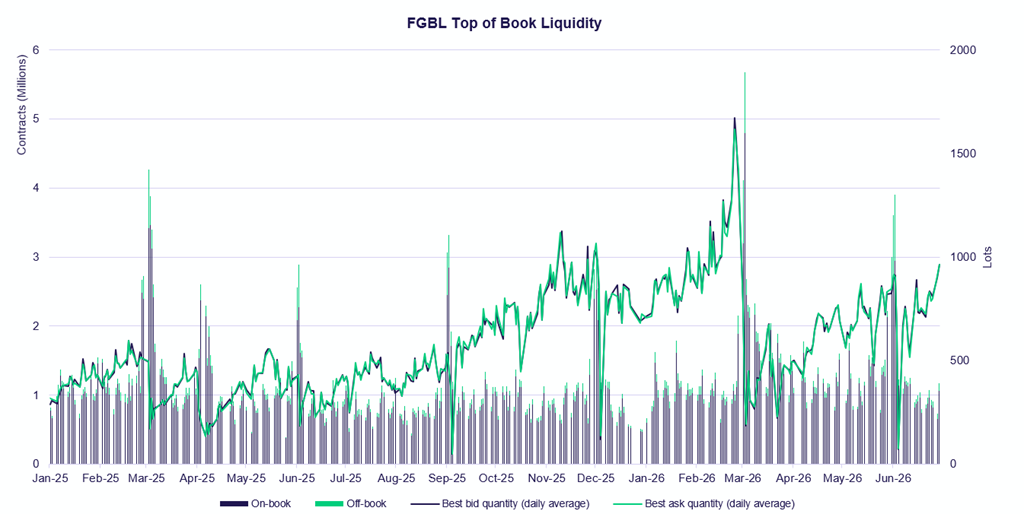
Market depth also improved. Following a temporary reduction during the June futures roll, FGBL top-of-book liquidity recovered strongly and reached 963 lots by quarter-end. In times of high market volatility, the LTIR suite remained resilient. Additionally, LPs actively supported liquidity in the calendar-roll order book, supporting an efficient roll.
Trading activity supported across the curve
Trading remained active across all maturity segments as investors responded to changing inflation and rate expectations. Average trade sizes in Q2 reached approximately 21 lots in FGBL, 37 lots in FGBM and 52 lots in FGBS.
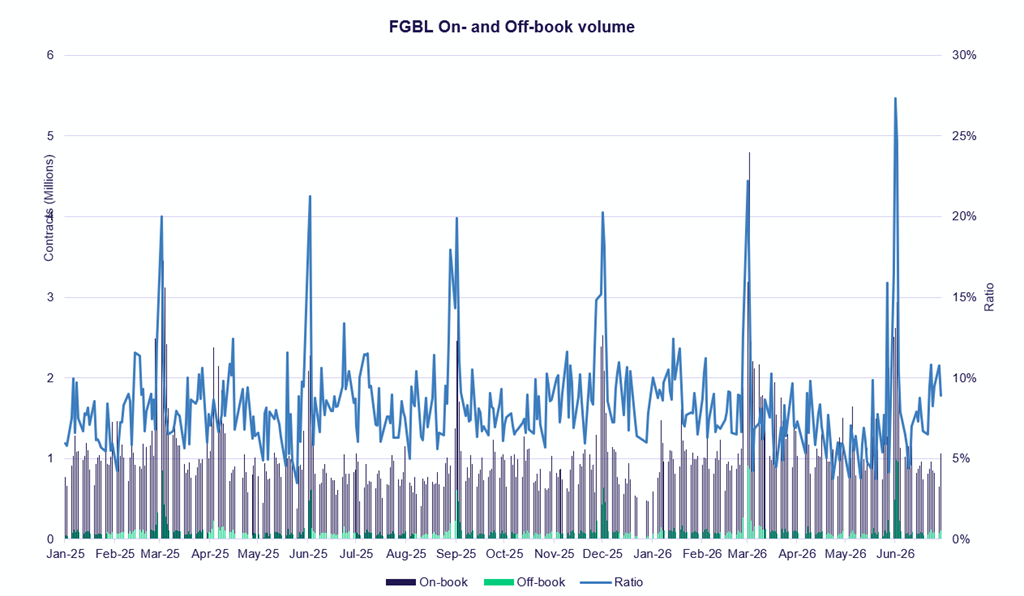
Importantly, on-book trading continued to dominate market activity, accounting for roughly 92 percent of total FGBL volumes, while off-book trading represented only around 8 percent of activity. This highlights the continued preference for transparent electronic trading venues during periods of uncertainty.
Outlook
Q2 2026 demonstrated the critical role that fixed income futures play during periods of market volatility. While geopolitical developments and central bank divergence drove significant market repricing, investors continued to benefit from deep liquidity, price transparency, cross-margining and efficient risk-transfer mechanisms.
The combination of rising volumes, increasing open interest, recovering order book depth, and consistently tight spreads suggests that the fixed income futures market remains well positioned to support participants as uncertainty continues into the second half of the year.
Das Markt-Statusfenster gibt Hinweise zur aktuellen technischen Verfügbarkeit des Handelssystems. Es zeigt an, ob Newsboard-Mitteilungen zu aktuellen technischen Störungen im Handelssystems veröffentlicht wurden oder in Kürze veröffentlicht werden.
Weiterführende Informationen zur Handhabung von Störungen finden Sie im Emergency Playbook, das Sie auf der Eurex Internetseite unter Support --> Emergencies and safeguards (nur in Englischer Sprache verfügbar) finden. Detaillierte Informationen zur Kommunikation während einer Störung, zu Wiedereröffnungsmaßnahmen und Handlungsempfehlungen für den Order- und Transaktionsabgleich finden Sie in den Kapiteln 4.2, 4.3 bzw. 4.4. Konkrete Informationen bezüglich der jeweiligen Störung werden während der Störung über Newsboard Message veröffentlicht.
Wir empfehlen dringend, aufgrund der Hinweise im Markt-Statusfenster keine Entscheidungen zu treffen, sondern sich in jedem Fall auf dem Produktion Newsboard umfassend über den Vorfall zu informieren.
Das sofortige Update des Markt-Status erfordert eine aktivierte und aktuelle Java™ Software für den Web Browser.