Oct 28, 2026
Eurex Exchange
LTIR quarterly market review – Q3 2026
Volatility fuels record activity across European bond markets
Rising geopolitical tensions, renewed inflation pressures and a significant repricing of sovereign risk defined the third quarter of 2026. As central banks returned to tightening mode and government bond yields surged globally, market participants turned increasingly to fixed income futures to manage risk. The result was a sharp rise in trading activity across Eurex's benchmark government bond futures complex, accompanied by resilient liquidity and expanding open interest.
Key findings
Global bond markets sold off sharply as energy-driven inflation, central bank rate hikes and quantitative tightening pushed yields higher across all maturities.
U.S. and German yield curves steepened, with 2s10s spreads widening to 40 bps and 38 bps respectively. The 10-year U.S. Treasury-Bund spread also widened to around 170 bps by quarter-end.
French sovereign risk became a major market theme, with the 10-year OAT-Bund spread widening to 130 bps, levels last seen during the Eurozone sovereign debt crisis.
Eurex fixed income futures volumes surged, with September trading volumes rising 68% year-on-year and year-to-date volumes up 27%. Open interest increased 26% compared with September 2025.
Liquidity remained robust despite heightened volatility, supported by resilient order book depth and strong participation from both on-book and off-book market participants.
Inflation fears and central bank action drive global yield repricing
The quarter was dominated by a renewed escalation of tensions in the Middle East, which disrupted transit through the Strait of Hormuz and triggered an energy supply shock. Rising oil prices reignited inflation concerns just as markets had begun anticipating a more accommodative monetary policy environment.
In September, both the Federal Reserve and the European Central Bank responded with 25 basis point rate hikes. The Fed increased its target range to 3.75%-4.00%, marking its first rate increase in three years, while the ECB raised its deposit rate to 2.50%. Combined with ongoing quantitative tightening and heavy sovereign issuance, the policy shift sparked a broad sell-off across government bond markets globally.
Rising yields reshape U.S. and German curves
Government bond yields in both the U.S. and Germany moved materially higher during the quarter as markets adjusted to a prolonged higher-rate environment. The steepening of yield curves reflected a combination of policy repricing at the short end and persistent inflation concerns further out the curve.
By the end of September, the U.S. 2s10s spread had steepened to 40 basis points, while Germany's reached 38 basis points. Meanwhile, the 10-year U.S. Treasury-Bund spread widened by approximately 9 basis points over the quarter, closing at around 170 basis points.
While macroeconomic developments drove global fixed income markets, France emerged as a distinct source of risk. Concerns around fiscal sustainability, rising debt levels and political uncertainty prompted a significant repricing of French sovereign bonds.
French fiscal concerns trigger sharp OAT repricing
The 10-year OAT-Bund spread widened from around 85 basis points at the start of September to 130 basis points by end of September. The move brought French risk premiums to levels not seen since the 2012 Eurozone sovereign debt crisis.
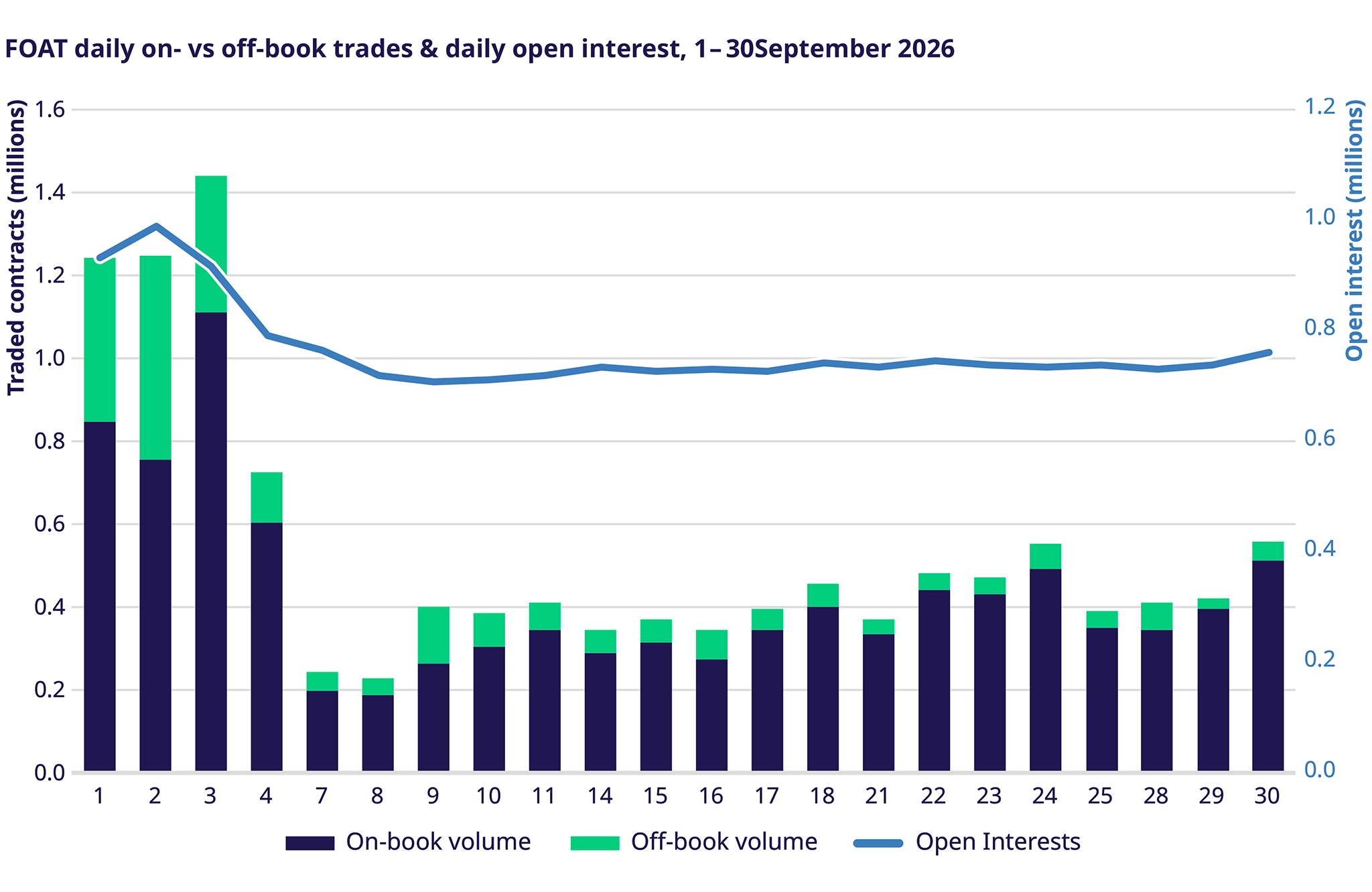
Despite the sharp volatility, trading conditions in Eurex's FOAT futures remained resilient. Order book activity continued to account for approximately 87% of trading after the roll period, while off-book activity increased significantly as market participants actively traded the cash-futures basis. EFP-related transactions represented 70-80% of post-roll TES volume.
Record trading activity as investors hedge risk
Periods of uncertainty often lead to increased derivatives activity, and Q3 2026 was no exception. Rising yield volatility, changing policy expectations and widening sovereign spreads fueled strong demand for fixed income futures as hedging and risk management tools.
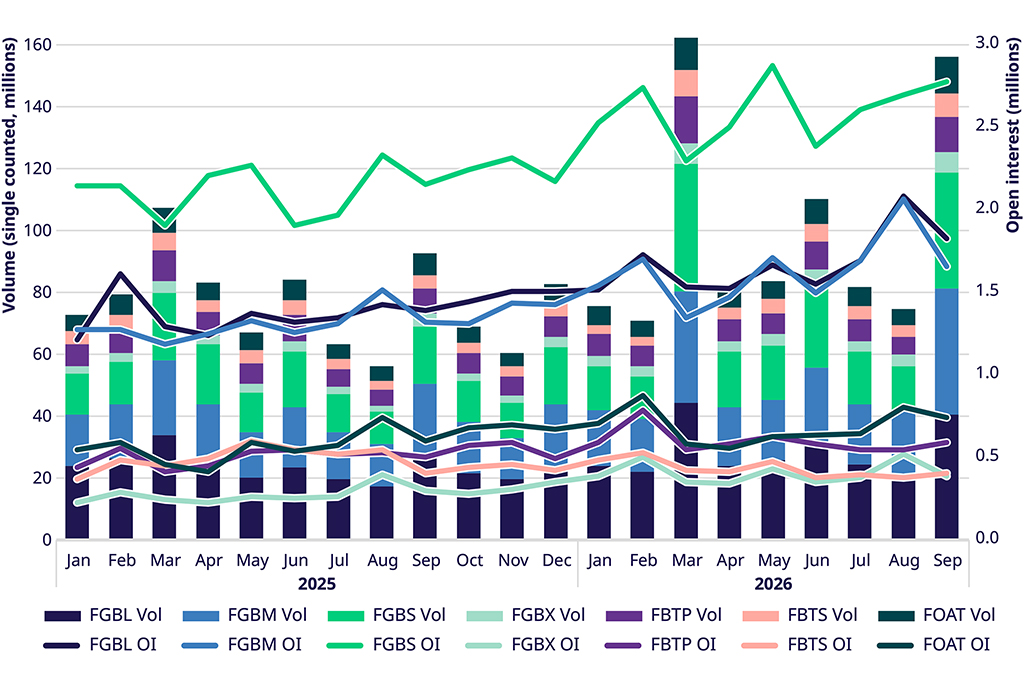
September trading volumes across Eurex fixed income futures rose 68% year-on-year, reaching 96% of the all-time monthly volume record set in March 2026. Year-to-date volume increased 27% compared with the previous year.
Regional activity remained particularly strong across core European government bond contracts:
Germany: 711 million contracts traded (+30% YoY)
Italy: 120 million contracts traded (+15% YoY)
France: 64 million contracts traded (+19% YoY)
Open interest also continued to build, rising 26% year-on-year in September and highlighting sustained market engagement.
Liquidity remains resilient during volatile markets
Notwithstanding the elevated volatility environment, market liquidity remained robust. Average top-of-book depth in the Bund future (FGBL) stood at 830 lots during the quarter. While liquidity temporarily fell during the September roll, it subsequently rebounded to a quarterly peak of more than 1,050 lots before ending the quarter at 668 lots as volatility intensified.
Trade sizes also increased across key benchmark contracts, with average sizes reaching:
FGBL: 22 lots (+6% QoQ)
FGBM: 43 lots (+16% QoQ)
FGBS: 57 lots (+10% QoQ)
At the same time, off-book participation reached record levels during the September roll, when more than 1.33 million contracts were executed off-book in a single day and off-book activity accounted for 56% of total trading volume.
Q3 2026 demonstrated how rapidly changing macroeconomic conditions can reshape fixed income markets. An energy-driven inflation shock, a return to central bank tightening and heightened concerns around French fiscal sustainability drove significant moves in government bond yields and spreads. Against this backdrop, Eurex fixed income futures experienced near-record trading activity, rising open interest and resilient liquidity, underscoring their role as essential tools for managing interest rate and sovereign risk during periods of market uncertainty.
