Dec 14, 2018
Eurex Repo | Eurex | Eurex Clearing
Marcel Naas: Challenges call for innovations
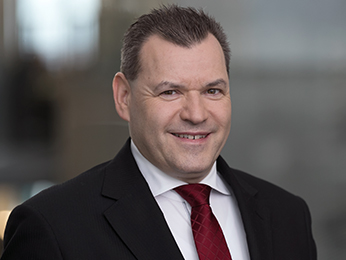
The European funding and financing market is facing a whole bundle of challenges. Also Blockchain, Cloud Computing, Machine Learning and Artificial Intelligence did not fail to have an effect on the repo and securities lending market. What are the challenges and how can the effects of digitization benefit our customers and us? We spoke to Marcel Naas, Managing Director, Eurex Repo GmbH and Head of Product Design Funding & Financing at Eurex.
What market trends are we experiencing in the European funding & financing market?
The European Central Bank is still buying up a significant amount of high quality liquid assets as part of their asset purchase programme. The thereby arising collateral shortage together with bank regulations for liquidity have caused a significant increase in demand for high quality liquid assets (HQLAs), which increases activity in securities-driven financing markets. This especially true for the repo market but as well for securities lending.
Next to that, the ECB’s unconventional monetary policy with its historically low yields leads to an oversupply of cash and continues to affect European money markets negatively by decreasing the demand for cash in the interbank market.
However, since the ECB reduced the net purchases of the asset purchase program in 2018, a stabilization of volumes in the cleared cash driven repo market can be observed.
Next to that, buy side demand for direct access models to Central Counterparties like Eurex Clearing are gaining importance within a strict regulatory environment.
An example: last year, ten new buy side participants were admitted to our “Eurex Repo Select Invest” product, which provides buy side firms such as corporates, insurance companies and asset managers access to our GC Pooling Market to provide cash to the interbank market. In addition, several pension funds and asset managers are in the final steps of on-boarding our “Select Finance” offering in order to raise cash in our interbank market via CCP.
What challenges are customers facing these days?
Unfortunately, the challenges are threefold. We have challenges caused by the explained market environment, but also regulation and political uncertainties.
The negative interest rate environment together with the ECB’s asset purchases have a major impact on European funding and financing markets. It pushes the rates of European government bonds into a negative field.
In addition, the crowding-out effect of the unconventional monetary policy creates an imbalance between supply and demand. As a result, we have a shortage of bonds available for securities financing transactions together with a shrinking liquidity in the cash-driven markets.
The regulatory requirements arising out of Basle III, CSDR or SFTR will assumingly reshape the structure and dynamics of these markets. Especially the introduction of the Basel III liquidity requirements namely the Liquidity Coverage Ratio (LCR), the Net Stable Funding Ratio NSFR and the Leverage Ratio have been influencing the funding strategies of sell side clients.
Another challenge for market participants is the introduction of a new benchmark rate. The ECB announced the Euro short-term rate (ESTER) as the most appropriate future euro risk-free rate to replace the EONIA as benchmark rate in 2020 (EU Benchmark Reform). However, the respondents of the consultation paper agreed with the working group to further consider assessing potential fall-back rates. And it is nice to see, that the STOXX GC Pooling Deferred Funding Rate of Deutsche Börse Group – a simple, robust and representative depiction of the cost of Pan-European wholesale short-term secured funding and strongly correlated to EONIA – has been recommended as the most appropriate “secured fall-back rate”.
Finally, we have the political uncertainties: The Brexit, US politics, as well as some elections in the European area have created volatility in the financial markets and lead to a flight-to-quality towards core European markets.
Given the role that London plays for funding and financing markets, where a lot of the collateral comes from core investment banks, who are essentially London based, the Brexit may have a significant influence on the market structure in the coming year.
Cross-border business in and out of the Euro zone today is essential and therefore the question about how markets will re-adjust post Brexit appears.
Could digitalization be the answer for the funding & financing market?
Distributed Ledger Technology
A ledger is a database which keeps a final and definitive record of transactions. Records, once stored, cannot be tampered without leaving behind a clear track. Blockchain enables a ledger to be held in a network across a series of nodes, which avoids one centralised location and the need for intermediaries’ services. It makes it possible for a ledger (a record of anything of value) to be distributed among all those using it, putting the responsibility to maintain and validate it in the hands of those using it.
These innovations and developments will provide many new possibilities and are game changers for our industry. For example, the Distributed Ledger Technology could be a way to provide trust, traceability and security in systems that exchange data or assets, meaning it can offer a lot of potential in areas such as financial services. This new technology stands for greater transparency, enhanced security and improved traceability. It also increases efficiency, speed and reduces costs.
A lot of potential that will especially benefit bilateral securities finance trading activities, because it can lower risks, reduce operational costs and complexity and thereby ease the fulfilment of regulatory reporting requirements.
Are there any specific systems or tools Deutsche Börse is currently working on?
A very interesting development is our partnership with HQLAx, which strengthens our commitment to new technologies in the post-trade sector. It will lead to significant progress in creating an innovative Distributed Lodger Technology solution and tackle the fragmentation in today’s markets.
As mentioned before, the implementation of new bank regulations for liquidity, mandatory clearing, and margin requirements for OTC derivatives have caused a significant increase in demand for High Quality Liquid Assets (HQLAs). As a result, there exists a heightened need for a marketplace to facilitate large scale, cost efficient collateral transfers across the global financial eco-system.
By collaboration with the financial technology innovation firm HQLAx we can unlock synergies given complementary service offerings across the value chain. In particular for trading with Eurex Repo and post-trade services offered by the new trusted third party of Deutsche Börse. Together with HQLAx, the aim is to create an innovative collateral swap solution leveraging the R3 Corda platform.
What is behind HQLAx, and what can market participants expect from the partnership?
Corda
is an open source DLT platform. Corda removes costly friction in business transactions by enabling institutions to transact directly using smart contracts, while ensuring the highest levels of privacy and security
Eurex Repo will expand existing F7 technology to offer exclusive electronic trading for DCR vs. DCR swaps of security baskets. Eurex Repo in the past already successfully transformed the money market to a standardized market by establishing securitiy baskets, which qualifies it as perfect fit for the new HQLAx offering. Next to that, Deutsche Börse will leverage functionalities of existing group entities to facilitate and control the rights and obligations of DCR creators and current holders.
This is another initiative with which we support our market participants to deal with the global regulatory framework whilst reaping the benefits of the leading edge distributed ledger technology.
