About EurexOTC Clear
EMIR 3.0 - active account
CCP Switch
On-boarding
Compression Service
Product Scope
Interest Rate Swaps
Inflation Swaps
Settlement Prices
Service Offering for PSAs
Clearing Member
ISA Direct Member
ISA Direct Light Licence Holder
Clearing Agent
Client
Jurisdictions
Multiple Clearing Relationships
Segregation Set up
Cross-Project-Calendar
Readiness for projects
C7 Releases
C7 SCS Releases
C7 CAS Releases
EurexOTC Clear Releases
Prisma Releases
Member Section Releases
Simulation calendar
Archive
User ID Maintenance
Clearing Hours
Clearing Reports
Product Specifications
Clearing on behalf
Delivery Management
Transaction Management
Collateral Management
Collateral
Transparency Enabler Files
Segregation Models
Reports
Default Fund
Intraday Margin Calls
OTC Clear Procedures
OTC Clear Tutorials
Cross Margining Support
Supplementary Margins
Default Waterfall
Model Validation
Stress testing
Default Management Process
Client Asset Protection under EMIR
Client Asset Protection under LSOC
Credit, concentration & wrong way risk
System-based risk controls
Pioneering CCP Transparency
Haircut and adjusted exchange rates
Securities margin groups and classes
Prices Rolling Spot Future
File services
Bond Clusters
Listed derivatives
OTC derivatives
Listed securities
Cash management
Delivery management
CCP eligible instruments
Eurex Newsletter Subscription
Circulars & Newsflashes Subscription
Corporate Action Information Subscription
Circulars & Readiness Newsflashes
News
Videos
Webcasts on demand
Publications
Forms
Events
FAQs
Production Newsboard
Eurex


Stable activity as minimum exchange day rule comes into effect with the June expiry
The roll into the September expiry saw similar volumes to previous rolls and was higher in comparison to June 2022. The introduction of the minimum exchange day rule ensured that there were no front month CTD switches, which, in turn, supported an orderly roll with Bund implied volatility remaining range bound around the 9% mark.
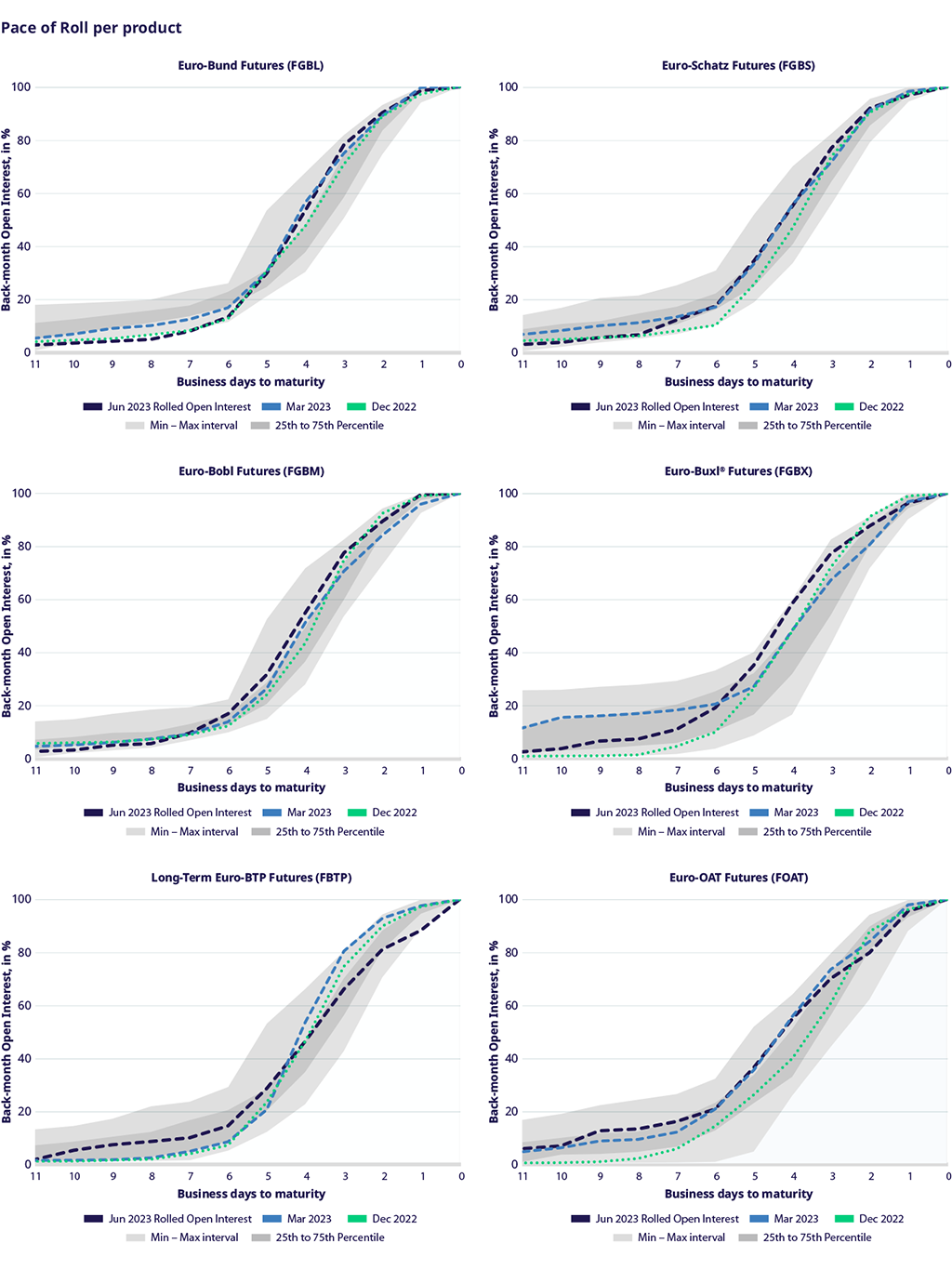
The buildup in open interest going up to expiry was steeper than the June expiry over the last two years. Similarly, we saw a steep decline in Open Interest after the roll.
Compared to the March 2023 roll, activity for June 2023 started later to expiry. This was most prominent for Buxl futures (FGBX), where activity was lower ten days prior to the last trading day. For the other contracts, shifting open interest into the back month picked up speed only six days out, following the trend of the March 2023 roll and December 2022 roll. This is most observable in Bund (FGBL) and Schatz (Schatz).
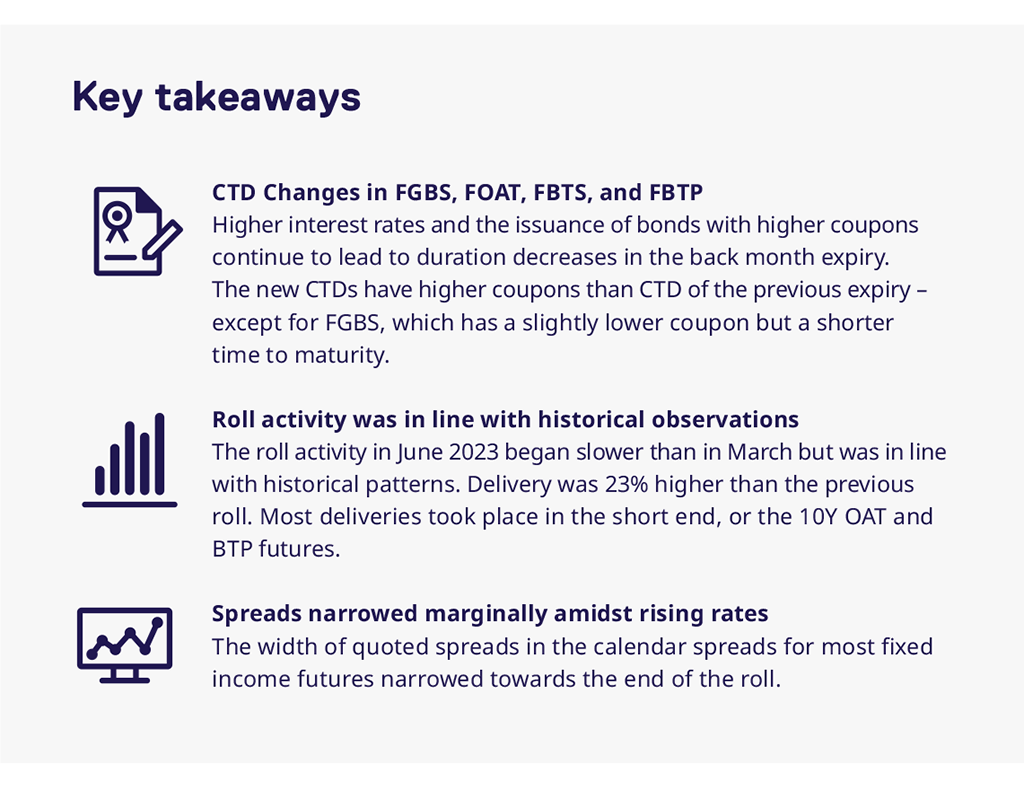
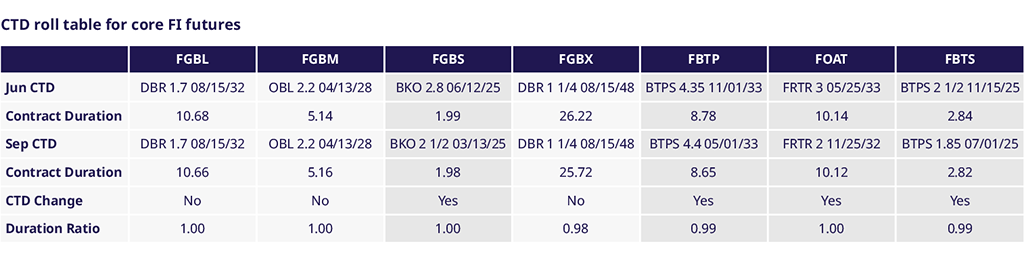
For Sep 2023 expiries, within the core German segment, the CTD bond changed only in the Schatz (FGBS), while in the European segment, a CTD switch occurred in the short-term BTP (FBTS), long-term BTP (FBTP), and OAT (FOAT). Contract duration decreased across all CTDs except for Bobl.

Trading volumes during the roll period (last nine days before expiry)
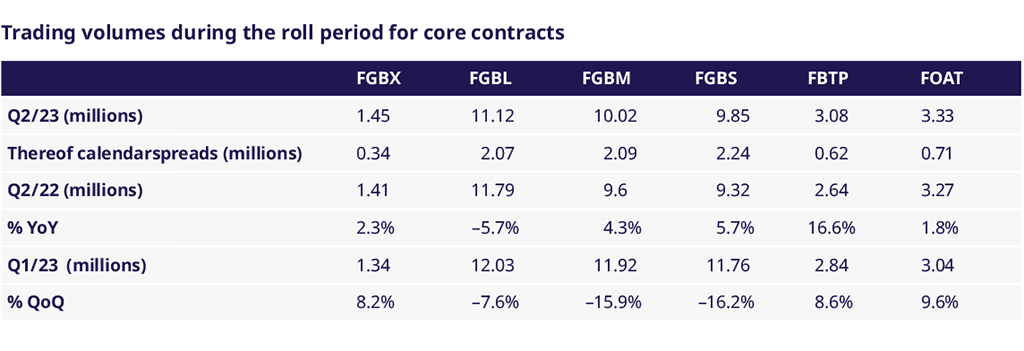
In addition to rolling contracts, we saw increased activity in the outright markets. Aggregated trading volumes across expiries during the roll days grew by just over 2% YoY for all contracts combined. We observed the highest trading volume increase in the BTP futures with +16.6% YoY.
In terms of deliveries, Buxl and Bund futures saw a slightly lower number of contracts delivered at 8.6k and 5.8k, down from 9k and 8k, respectively. In Bobl, participants had netted out significantly more positions than previously, as the number of contracts going into delivery was 9k, down from 73k in March. Schatz futures saw an increase in delivered contracts up from 26k to 45k. The deliveries for short-term and long-term BTP futures more than tripled from 14k and 13k contracts delivered in March to 43k and 58k in June 2023. OAT futures delivered 23k contracts in Q2, up from 14k in Q1. For more information on the delivery, please see here.

Calendar Spreads narrowed throughout the roll period

Calendar spreads remained stable for Bund and Bobl futures while Buxl, Schatz, BTP and OAT futures narrowed throughout the roll period, with Buxl having the smallest spread on the last day at 0.2 EUR.
German products saw calendar spreads compressing over the roll period (May 29 -Jun 8) while being rangebound to less than 8bps in deviation from the beginning of the roll. Bobl saw the smallest price decrease of 1bp, followed by Bund and Buxl at 2bps and 3bps, respectively. In the European south, Long Term BTP and OAT futures saw spreads decrease 12bps and 19bps over the roll.