Aug 27, 2018
Eurex | Eurex Clearing
Our ear to the ground: Eurex sales staff in interview
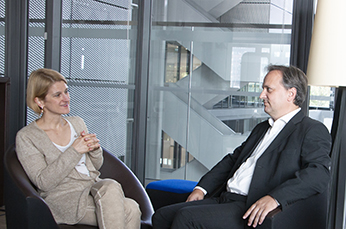
The best product development in the world is of little use if customers do not get to hear about new products and services. Clients need a contact at Eurex who listens to them and takes their interests to heart. We speak to two Eurex Sales colleagues, Simona Simon and Andreas Stadelmaier, who are both in constant touch with their clients. Simona is Senior Vice-President in Global Equity & Index Sales and Andreas Senior Vice-President in our Fixed Income EU Sales unit. In the first part of this series, we focus on client needs.
Simona: You first, Andreas, as Brexit and OTC clearing are probably the most important.
Andreas: Exactly, Brexit, euro clearing and regulatory developments are top of the list. As an answer, we launched the Partnership Program at the beginning of the year, where we invited the community including all of the banks to participate, to bring liquidity to Eurex OTC clearing up to speed – and we’ve had huge success so far.
What about efficiencies?
Andreas: Yes, clients are very hot on cost efficiencies, competitive bid/offer prices, collateral flexibility and optimization of trade flows. Even on reasonably newly established trade flows, such as on OTC IRS [Over-the-Counter Interest Rate Swaps] set up a few years ago, clients are already changing workflows to optimize processing, bringing it down from a few hours to a few minutes.
We also have discussions on the side effects of capital requirements and regulatory requirements. Overall, it’s simply that everyone in the market needs to adjust their work flows to match the requirements and be ready for future challenges.
What weighs more, regulatory requirements or cost awareness?
Andreas: Well, the one drives the other, probably! Regulatory requirements have increased a lot, but for good reasons. A good percentage of the new regulatory rules result from the Lehmann case and we have to remember that that was ten years ago. With the new regulations in place, there is still need for some fine-tuning.
MiFID II brought huge changes on the trading side and EMIR on the clearing side. Market participants had to understand the multiple aspects of the regulations and had to fine-tune their set-ups, especially regarding capital costs. As a result, we now see the XVA desk (see box below), something that didn’t exist a few years ago. These desks calculate the capital cost of a potential trade and traders have to embed those costs in their pricing. Another example – collateral management, which was done somewhere in the back office a few years ago. Nowadays it is a special team in the front office looking into collateral optimization. The world has changed dramatically.
Where does Brexit come into this?
Andreas: Brexit adds a new flavor to everything and we have to see where this will lead to. In the end, the outcome depends on political decisions. But, our clients, the banks, the asset managers and the investment companies all need to prepare for it now.The next seven months will be very busy for us. Everyone needs to have a solution in place, even though we don’t know how the Brexit outcome will work out – but doing nothing is not a solution!
Simona, is there a difference for equity and index customers?
Simona: Yes, probably from a business-as-usual perspective. We already have a lot of banks and proprietary trading firms active on our exchange and what they are mostly focusing on is the futurization process. In other words, due to capital costs and as a result of the risk management off-setting possibilities clearing houses are offering, a lot of participants are looking into bringing OTC swaps into exchange-traded derivatives.
Is there any special focus?
Simona: We’re mainly focusing here on our new products in the delta one space (see box below). This is one area where we are seeing customer demand. We are in constant exchange with the market and permanently developing new products with them. For example the entire swap market, where about 18 months ago we introduced the Total Return Futures (TRF) on the EURO STOXX 50®. We’re now continuing this with consultations regarding equity TRFs and basket TRFs. Take, for example, our very successful dividend derivatives segment. By introducing EURO STOXX 50® index dividend futures in the past, the futurization process was kicked off. Swaps were migrated into the listed market with the support of numerous banks.
So that means this alternative was in place, or at least in the conception phase, before the financial crash?
Simona: Yes, we listed dividend interest futures in June 2008, before the final crash as demand was already there from a certain group of clients. That product is a good example of how the futurization process developed. One of the main points in the ETD (exchange-traded derivatives) world on the equity side is trying to bring more and more products, particularly more sophisticated products, onto the exchange. This poses more challenges, not just for us but also for the clients, because they’re not just a copy and paste of one of the thousands of existing products on the exchange. We’re adding complex products from the OTC space, fitting them to our contracts, our rules and regulations, which is quite challenging.
Is the equity and index world less affected by geopolitical events?
Simona: Looking at the ETD market, the equity and the index side, we were already listing more and more products even before the financial crisis, and continued to add additional ones at the same pace afterwards. Whereas in the fixed income space, we were living for years and years with the main benchmark futures and not looking too much at the OTC space. But, with 2008, and especially with mandatory clearing, this is an entire new area which has had to be tackled. This was not so urgent on the equity side.
Explanation of terms
Delta one
Financial derivatives that have no optionality and as such have a delta of (or very close to) one – meaning that for a given instantaneous move in the price of the underlying asset there is expected to be an identical move in the price of the derivative. Delta one products often incorporate a number of underlying securities and thus give the holder an easy way to gain exposure to a basket of securities in a single product.
XVA desk
Desk at a bank responsible for managing all derivatives valuation adjustments (DVA) at the bank: DVA, counterparty valuation adjustment (CVA), funding valuation adjustment (FVA) and, more recently, K-CVA, where K stands for the capital requirement under Basel II regulatory calculations.
