Sep 03, 2026
Eurex
How Credit Index Futures have proved their worth in 2026

The extreme volatility in credit markets during March 2026 provided a stress test for the nascent suite of Credit Index Futures on Eurex. It was a test they passed with flying colors with an acceleration of adoption and record block trading activity – proving their role as a viable risk management tool to the buy side.
Initially launched by Eurex in 2021 to provide a listed alternative to OTC markets, Credit Index Futures have grown significantly in scope and liquidity over the past five years. Today, Eurex offers six futures contracts on credit indexes including high-yield and investment-grade underlyings across Euro and USD.
For buy-side firms gathering at PostTrade 360, the growth of Credit Index Futures presents significant opportunities. The products are being used today by asset managers and hedge funds to fine tune exposures, hedge risk, and take positions on credit in a listed environment, with all the transparency, regulatory and counterparty risk-reduction benefits that brings.
A proven instrument for credit markets
Credit markets in the first six months of 2026 have been exposed to several significant shocks. Most notably, global markets reacted strongly to inflationary concerns in the immediate aftermath of the closure of the Strait of Hormuz and the impact on global supply chains, fertilizer and energy prices.
However, the wider spreads in credit markets in the wake of the outbreak of war in Iran were short-lived. Spreads in the key global credit indicators fell back from their March highs by late May. This recovery continued despite record-breaking new issuance with notional outstanding in the Bloomberg Euro High Yield Index increasing by EUR 27 billion between January and June and the Euro Corporate Aggregate Index by EUR 100 billion over the same period.
Eurex’s Credit Index Futures proved their worth during this period of intense market activity with record trading volumes. Around 700,000 contracts traded across the suite in H1 2026, accounting for around EUR 55 billion of notional and taking the cumulative total since launch past three million contracts and EUR 248 billion. Open interest hit record highs of 60,000 contracts in May, equivalent to more than EUR 5 billion of notional.
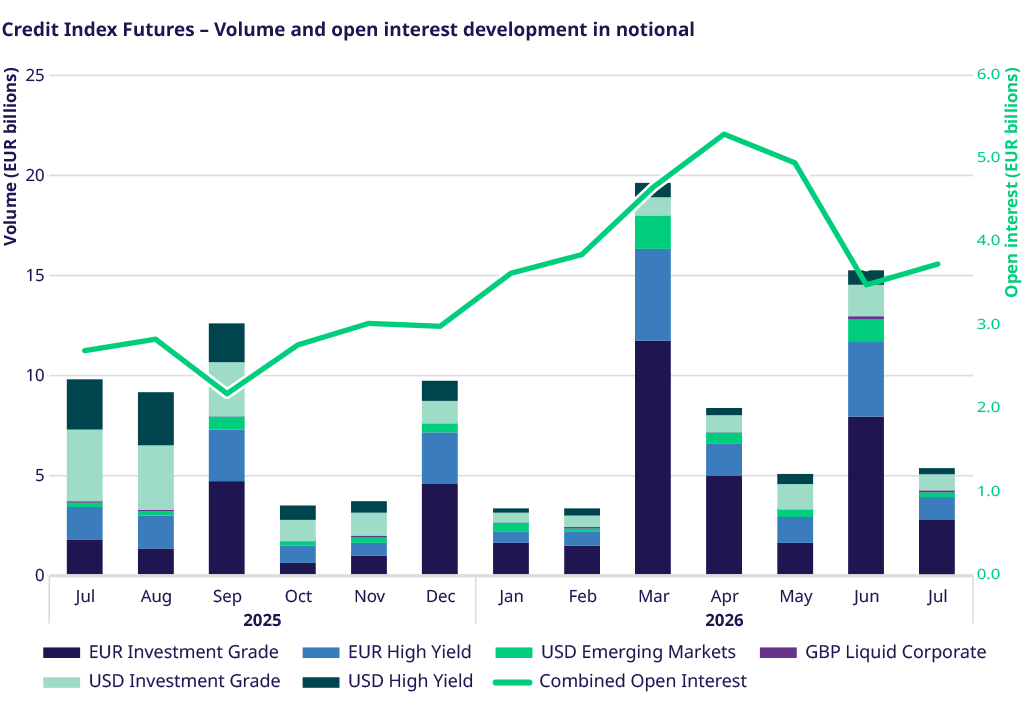
Adoption and engagement with the contracts also increased. The number of active end-users on the platform surpassed 110 during the first six months of 2026, and block trading, the most common source of liquidity in the market, exceeded the total volume recorded in 2025 before the end of H1 2026.
Activity in March was particularly high. As oil prices spiked and inflationary concerns rose, the market quickly adjusted positions to reflect the new economic reality. This resulted in an all-time monthly record of 240,000 contracts traded, equivalent to close to EUR 20 billion in notional.
"March 2026 was a perfect use case for hedging," says Davide Masi, Global Product Lead for Credit Derivatives at Eurex. "Real-money asset managers were using the product to cover their portfolios against potential losses coming from the corporate bond side."
Use cases for Credit Index Futures
The short-lived increase in spreads during March provided the perfect rationale to trade Credit Index Futures. As energy prices climbed alongside inflationary fears, investors needed a fast, liquid way to reduce exposure without significant alterations to carefully constructed cash bond portfolios. Once conditions stabilized, the futures contracts added equal efficiency in restoring exposures and taking advantage of the credit spreads tightening.
That is just one of several key use cases. Using the futures, the buy-side can take short or long positions across Eurex’s investment grade, high-yield, USD investment-grade, USD high-yield, emerging markets and sterling corporate credit instruments.
The Credit Index Futures also allow investors to isolate credit risk. By combining Credit Index Futures with Eurex’s Bund, Bobl or Schatz futures, investors can strip out the credit component of their exposure and hedge that in isolation.
Beyond the acute, event-driven use cases, Masi points to several other benefits of using the products. "A key buy-side use case is cash management,” he says. “Clients can use Credit Index Futures to invest unused cash, get the full return of corporate bond benchmark indexes, and effectively park that cash ahead of reinvesting into a new opportunity, or waiting until they have more cash to deploy.
"Another year-round use case is tactical and strategic asset allocation, which is especially relevant for multi-asset portfolios. Eurex has a global multi-asset product suite, so via one exchange and one pool of liquidity providers, clients can now invest across equities, rates and credit globally.”
There are also capital-efficiency benefits to using Credit Index Futures. All the contracts clear at Eurex Clearing, which offers cross-margining among instruments within the same product group, including rates and FX futures and options. This allows investors to offset long and short positions across the suite, reducing overall margin requirements.
Another capital benefit comes from the leverage that futures allow. Using the futures contracts, buy-side firms can gain leveraged exposure without committing the full notional in cash.
Growing participation and liquidity
Adoption in the contracts has increased steadily as volumes have grown, both in terms of the number of users and the scope of companies engaging with the product. The early adopters of Credit Index Futures across the buy-side were multi-asset desks, who were attracted by the products' flexibility and the ability to fine-tune positions.
That was followed by credit portfolio managers, who used the products for both positioning and hedging. More recently, liquidity and volumes have reached a level where hedge funds are engaging with the contracts. These firms are pursuing relative value strategies such as trading one Credit Index Future against another, or futures versus CDS index trades.
The growing adoption in H1 2026 has resulted in part from how liquidity is provided in the contracts. "One thing we worked on throughout 2026 was improving liquidity in the order book for our Credit Index Futures," says Masi. "We made significant progress in increasing the liquidity available at the top levels of the order book. That has resulted in increased activity throughout 2026, and in particular in July, when we further strengthened our incentive framework."
However, for buy-side firms that want to trade in size, the order book is only part of the picture. "The largest transactions are always executed as blocks," Masi notes. "That is where we feel our Credit Index Futures really excel in terms of liquidity, and 2026 was a record year for our product suite. The record daily trading volume in the product suite was broken twice: in March with 49,000 traded contracts, and in June , with over 60,000 contracts traded in a single day. Moreover, July saw the largest ever outright block trade, totaling more than EUR 500 million in Euro Investment Grade Index Futures."
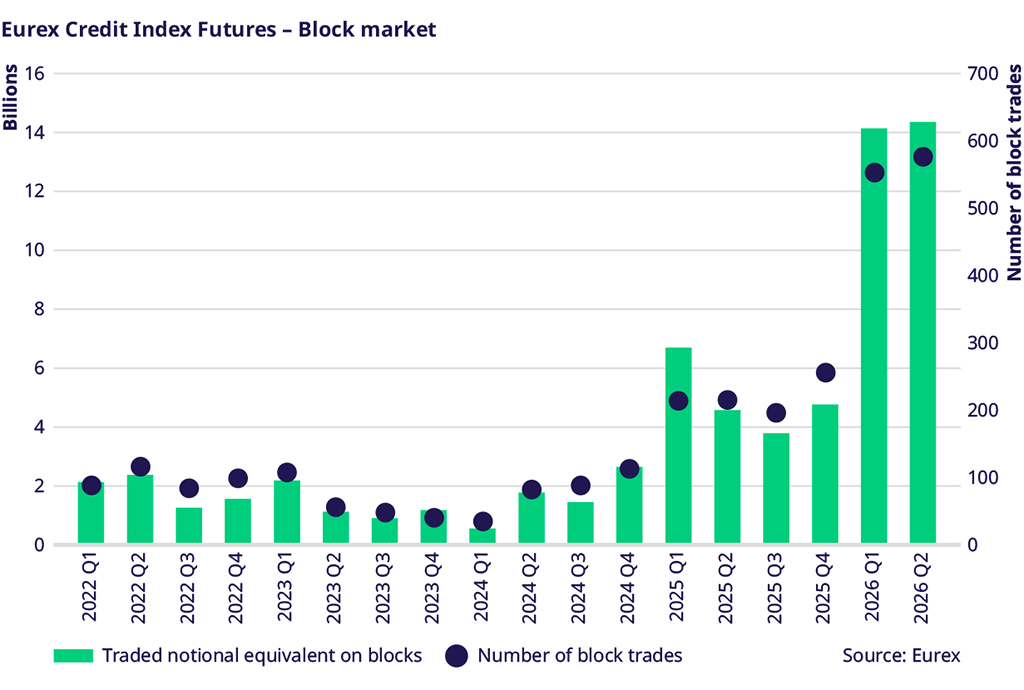
Clients looking to execute in the block market can submit an RFQ which goes out to dealers in a competitive bid process. Masi says that quotes are usually received in a matter of seconds and this route to market saves significant amounts of time working a large order through the book.
Uncertainty and volatility are set to be a feature of credit markets for the rest of 2026 and beyond. For buy-side credit traders, Eurex’s Credit Index Futures have shown their value in volatile markets and in credit portfolios as a whole. These versatile products are likely to gain increased traction in the months ahead.
The article was first published on PostTrade 360.
